Overview of the Whatfix Mirror Dashboard
Share Whatfix Mirror
Whatfix Mirror enables you to share simulated application environments with your learners without giving them access to the live application, including individual Workflows or Simulations. Share the Mirror directly with your learners using email or any messaging application to give them access to the simulated application environment captured using Whatfix Studio.
When you share a Workflow or Simulation, Whatfix provides a Unified Mirror Link. The link remains the same as the Workflow or Simulation moves across dashboard stages. For more information, see Unified Mirror Links and Understand Whatfix Dashboard Stages.
Based on your requirements, you can share Workflows and Simulations in the Draft, Ready, and Production stages. Consider the following examples:
- Draft Stage Mirrors: Share Mirror content in the Draft stage for internal review with your team.
- Ready Stage Mirrors: Share Mirror content in the Ready stage for review with your partners.
- Production Stage Mirrors: Share the finalized and reviewed Mirror content with your learners.
Mirrors function independently of the Whatfix Digital Adoption Platform (DAP), so your learners do not need to install or embed Whatfix to interact with the Mirror. However, if the Mirror contains DAP Guidance, Whatfix needs to be installed. For more information, see DAP Guidance on Mirror.
To ensure that a shared Mirror displays DAP Guidance, you must publish the corresponding DAP Guidance from the Whatfix Guidance Dashboard. If the DAP Guidance is not published, your learners can access the Mirror but won’t see any DAP Guidance. For more information, see Create DAP Guidance on Mirror.
- If your organization has configured end-user authentication, learners must verify their identity before accessing a shared Mirror. For more information, see Set Up Email-Based Authentication and Set Up Single Sign-On.
- Whatfix Mirrors cannot be shared from Whatfix Studio and must be shared from the Whatfix Mirror Dashboard.
Expand the following accordions for more details:
Share a Mirror Workflow
Share a Mirror Workflow when you want your learners to follow a linear, predefined path and complete a single task from start to end.
For example, share a Workflow for logging a case in Salesforce, guiding learners through each step in sequence.
- If you want to share Workflows in the Draft or Ready stage, follow the same steps as follows in the Ready stage.
- Mirror does not capture data or record activity for Workflow usage in the Ready stage, and the data does not appear in the Mirror Analytics dashboard. Analytics data is captured only for Workflows that you publish and share in the Production stage.
Use the following steps to share a Mirror Workflow:
- On the Whatfix Mirror Dashboard, go to the Production stage.

- Hover your cursor over the Workflow you want to share.

- Click the More icon.

- Click Share.
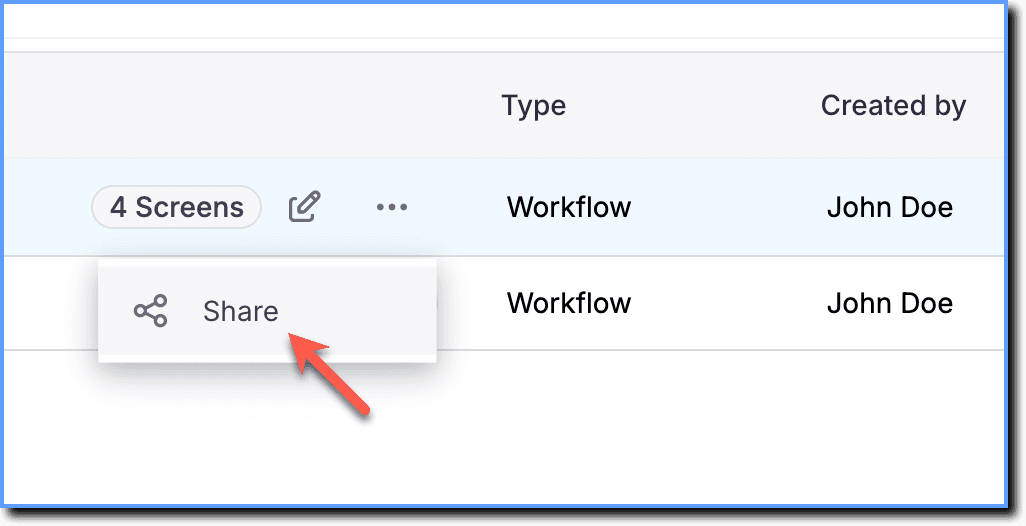 5. Click the Open icon.
 6. Select the required Language Variant you want to share. For more information, see Multi-Language Support in Mirror and Create Language Variants in Mirror.
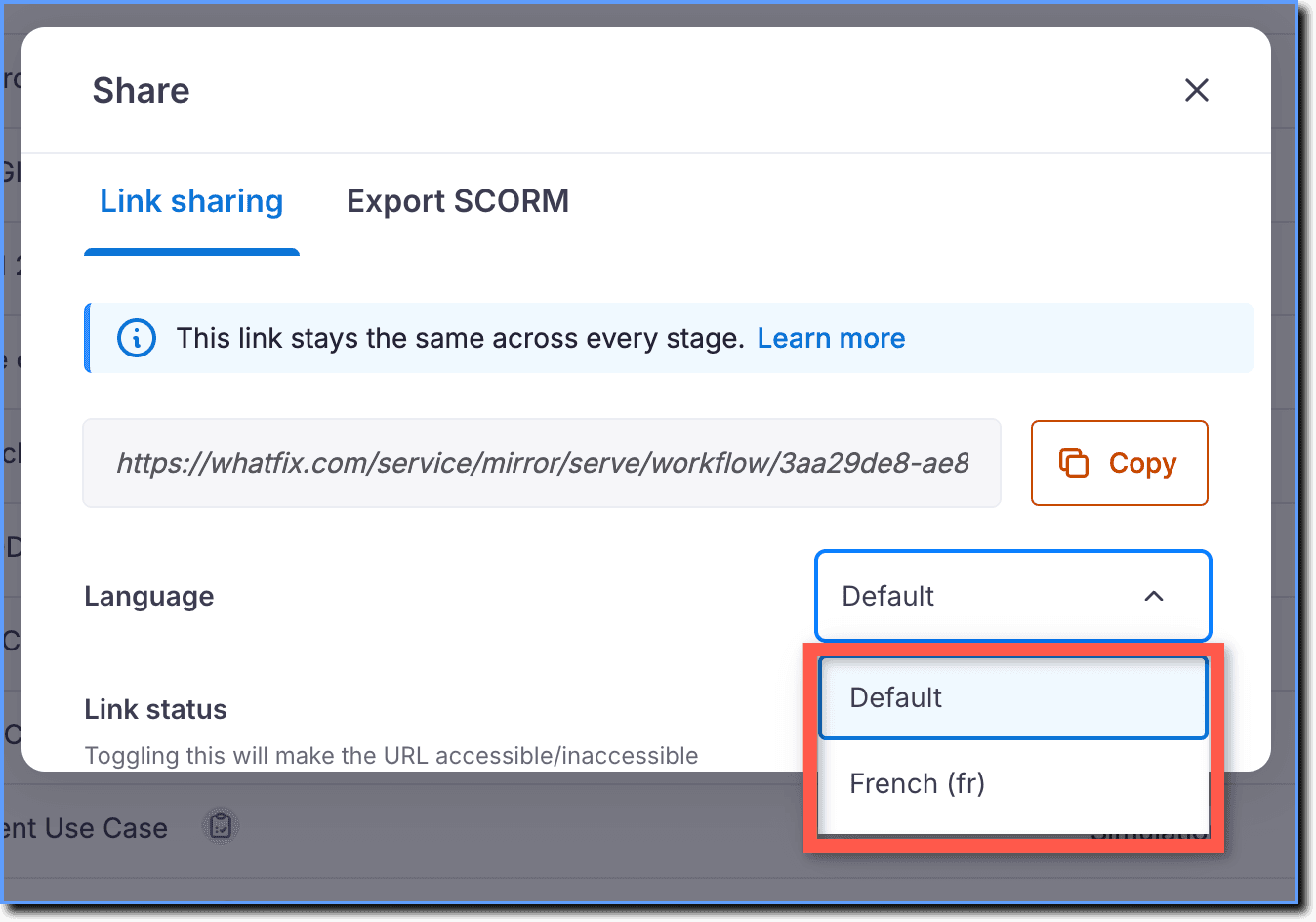
- Select the Flow checkbox to include the auto-created Flow in the link. For more information, see Auto Create a Flow.

- Select the AI Roleplay checkbox to include the AI Roleplay in the link. For more information, see Create an AI Roleplay.
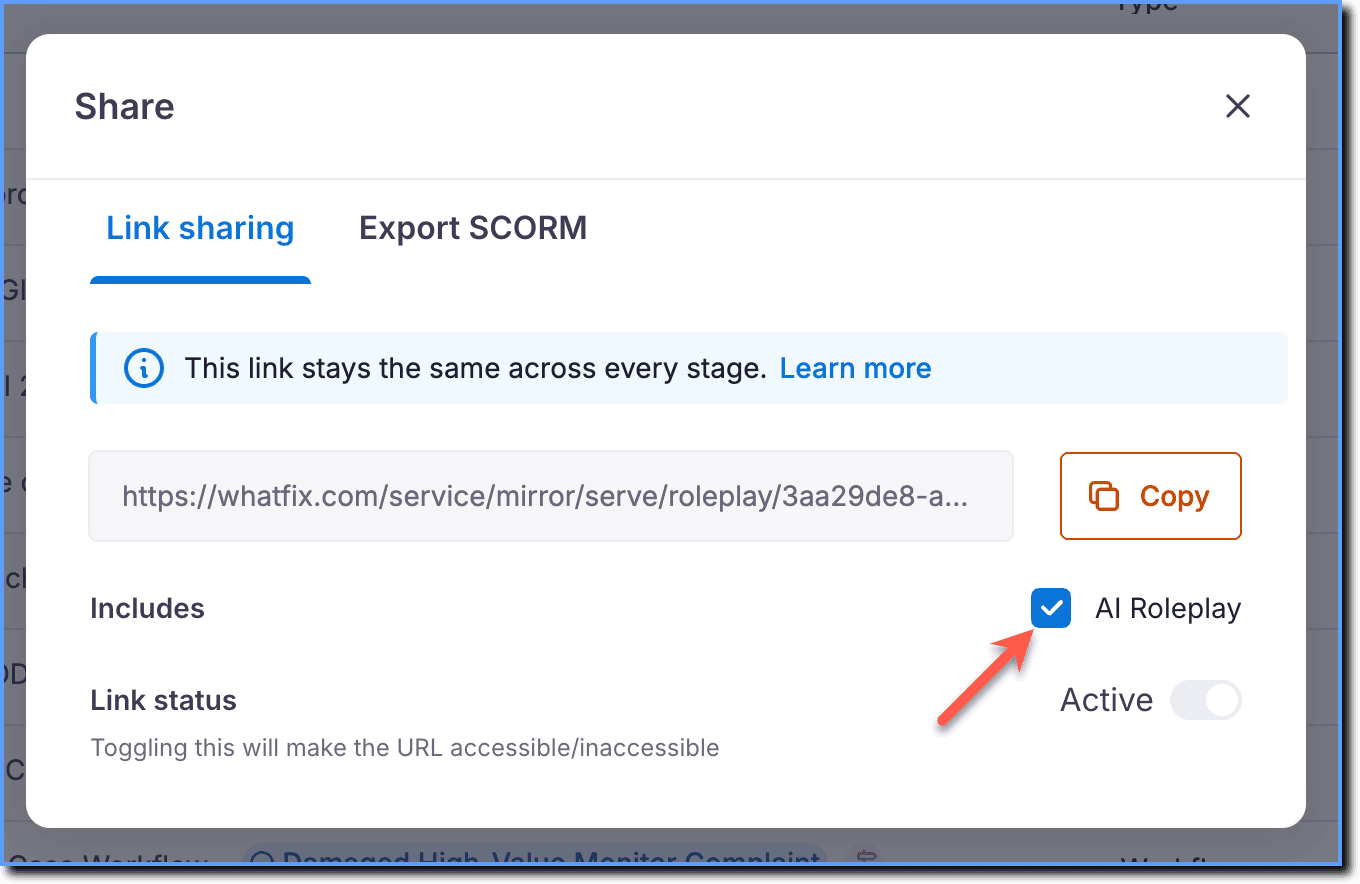
- Additionally, if your Workflow or Simulation contains both an auto-created Flow and an AI Roleplay, select the Flow checkbox and the AI Roleplay checkbox to include both in the link.

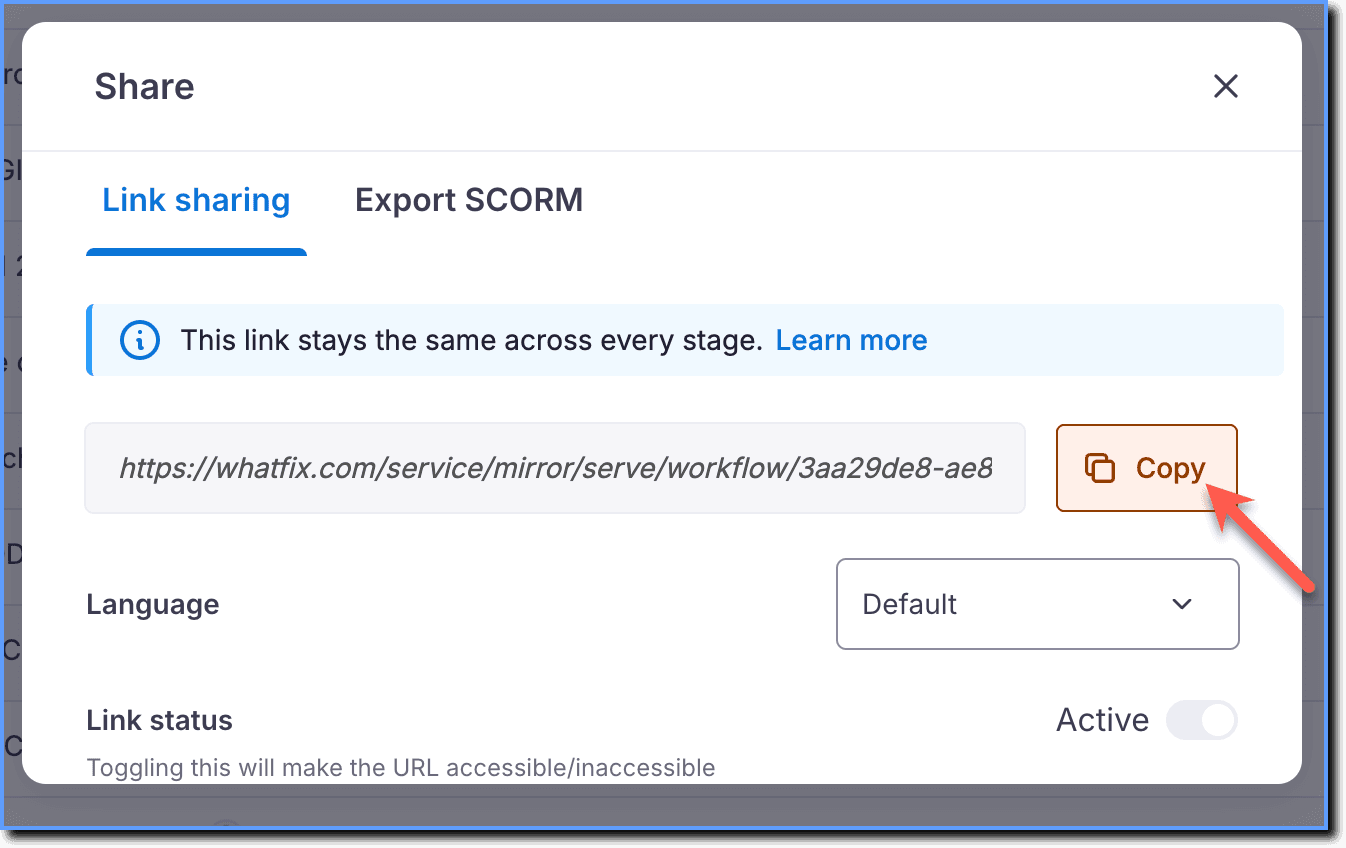
- Click Copy, and then share the link with your learners.
Share a Mirror Simulation
To share a Mirror Simulation, select a Workflow within the Simulation to define the starting point. Navigation between other Workflows depends on the Playground Mode configuration. For more information, see Understand Playground Mode.
For example, when Playground Mode is enabled, learners can navigate across all Workflows in the Simulation. When Playground Mode is disabled, learners can access only the selected Workflow.
- If you want to share Simulations in Ready, perform similar steps as follows in the Ready stage.
- Mirror does not capture data or record activity for Workflow usage in the Ready stage, and this data does not appear in the Mirror Analytics dashboard. Analytics data is captured only for Workflows that you publish and share in the Production stage. For more information, see Mirror Analytics.
Use the following steps to share a Mirror Simulation:
- On the Whatfix Mirror Dashboard, go to the Production stage.
 2. Hover your cursor over the Workflow that you want to serve as a starting point in the Simulation.
 3. Click the More icon.
 4. Click Share.
5. Click the Open icon.
6. Select the required Language Variant you want to share. For more information, see Multi-Language Support in Mirror and Create Language Variants in Mirror.
- Select the Flow checkbox to include the auto-created Flow in the link. For more information, see Auto Create a Flow.
- Select the AI Roleplay checkbox to include the AI Roleplay in the link. For more information, see Create an AI Roleplay.
- Additionally, if your Workflow or Simulation contains both an auto-created Flow and an AI Roleplay, select the Flow checkbox and the AI Roleplay checkbox to include both in the link.
- Click Copy, and then share the link with your learners.
- Whatfix enables you to export a Mirror as a SCORM package to integrate with your Learning Management System (LMS). For more information, see LMS Integration.
- Mirror tracks end-user engagement and performance across the Workflows and Simulations you share in the Production stage. View analytics such as completion rates and interaction trends in the Whatfix Mirror Dashboard. For more information, see Mirror Analytics.
Whatfix Mirror is an application simulation software that provides an immersive and interactive simulation of any web application.
A sequence of captured mirror screens representing a specific user journey or process (e.g., "How to create a Lead in Salesforce?").
A feature that enables you to connect and link multiple Mirror Workflows to represent a complex user journey across an application or ecosystem. Workflows added to a simulation are automatically linked.
Whatfix Studio is a browser plug-in that enables you to create various types of Whatfix content, such as Flows, Smart Tips, Beacons, and so on. The plug-in can be installed on Google Chrome and the new Microsoft Edge browsers.
A single URL that provides access to Mirror content, such as Mirror Workflows, Mirror Simulations, Assessments, and AI Roleplays, across the Draft, Ready, and Production stages. The URL remains the same as the content moves between stages.
In-app content types such as Flows, Smart Tips, Beacons, and Pop-ups that guide users through tasks.
A version of the default language variant captured in a different language. Language variants are stored within the same workflow and share the same stage.
A mode within Simulation that facilitates the connection and interaction of workflows within the simulated environment. Playground mode is enabled by default.
SCORM stands for Sharable Content Object Reference Model. SCORM packages enable you to share web-based learning with ease and reuse it across different eLearning platforms.