Insights
What is the difference between Funnels and User Journey?
Funnels and User Journey serve distinct purposes in analyzing user behavior and engagement.
Funnels focus on specific sequences of predefined steps that users take to achieve a specific goal or conversion.
Funnels provide the following insights:
- Completion and drop‑off rates
- Time taken per step
- Bottlenecks that block conversion
Use Funnels when you need to optimize a specific workflow or conversion path.
Here is an example of what a Funnel looks like. 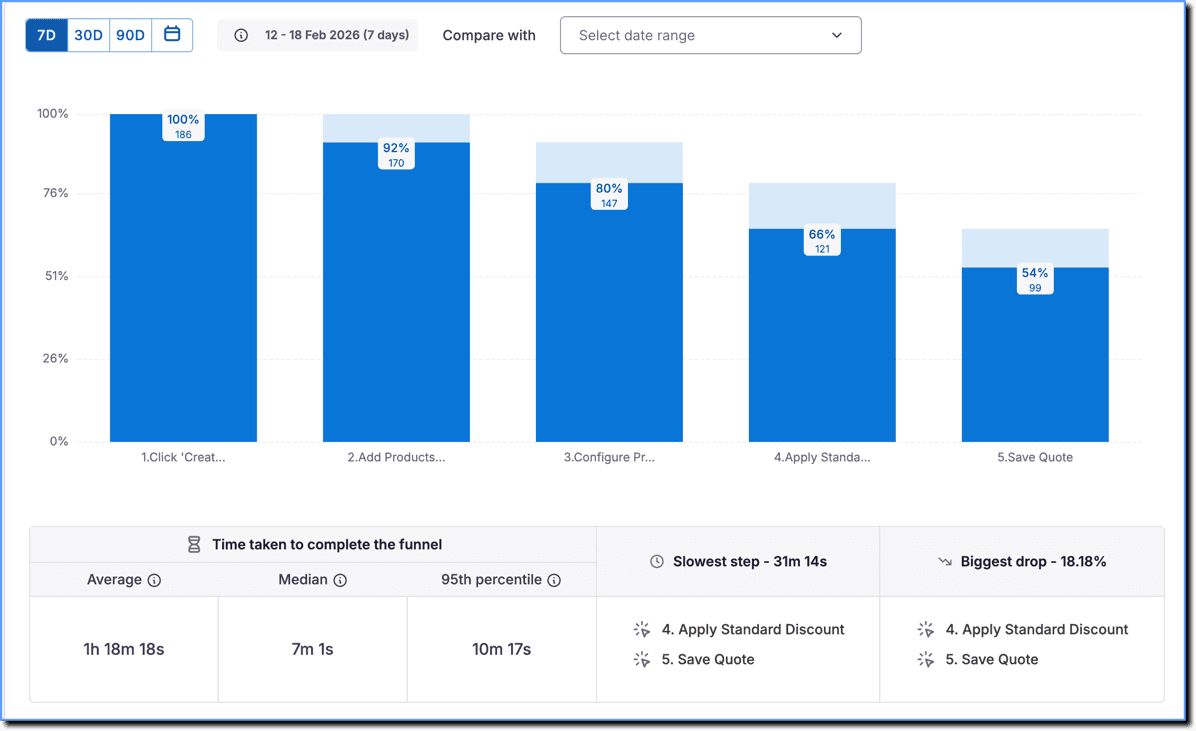
User Journeys map the entire session, enabling you to see every action and touchpoint a user encounters. It reveals:
- The full path users take, including detours
- Repeating patterns and common sequences
- Hidden pain points or moments of delight
Use User Journeys for a holistic view of engagement across pages and features.
Here is an example of what a User Journey looks like. 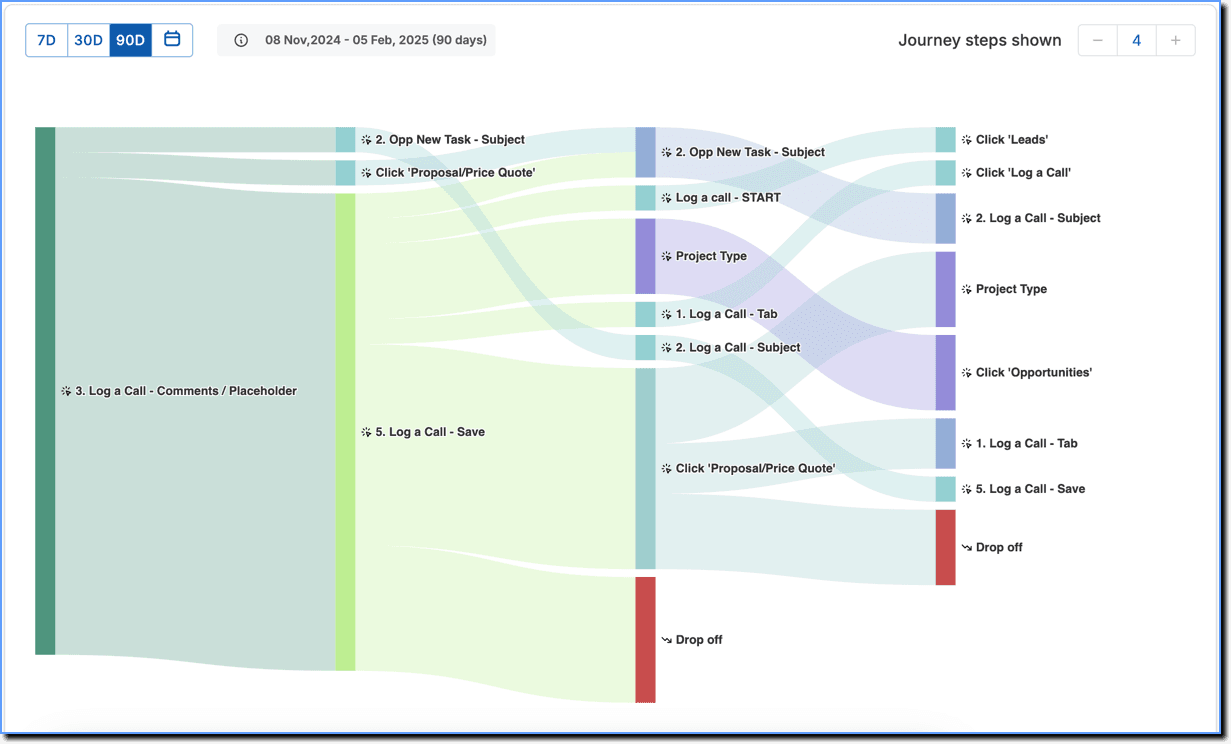
Here is a table summarizing the key differences between a Funnel and User Journey.
| Funnel | User Journey | |
|---|---|---|
| Scope | Focuses on specific sequences of predefined steps or events. | Encompasses the entire end-to-end user experience. |
| Structure | Linear and predefined with a clear start and end point. | Flexible and can encompass multiple paths and interactions. |
| Focus | Conversion rates, drop-off rates, and user behavior. | Overall user experience, engagement, and behavior. |
| Purpose | Optimize user flows, track conversions, and specific actions. | Understand user engagement, identify pain points and issues. |
- Use a Funnel when you want to improve goal‑oriented flows. Examples: checkout, onboarding.
- Use a User Journey when you need to see the big picture across all user interactions.
Funnels pinpoint where users struggle, while User Journeys explain why.